Pleasant Hill draws two very different groups of people toward CPR training, often for very different reasons. One is the workforce connected to John Muir Health’s Pleasant Hill medical office and outpatient facilities, where employers frequently require a current BLS card as a condition of employment. The other is families who spend weekends on the Iron Horse Trail, the paved path that runs through the city and stays busy with cyclists, runners, and kids on bikes. Before you register for a class, it helps to know that “CPR training” isn’t one single thing. A community CPR and First Aid class and a BLS provider course cover different material, take different amounts of time, and serve different purposes, so the right choice depends on why you actually need the card.
Key takeaway: BLS CPR certification is the provider-level course most healthcare and clinical-adjacent employers require, while a standard CPR/First Aid class is usually enough for parents, coaches, and general household preparedness.
What Sets a BLS Course Apart From General CPR Training
BLS stands for Basic Life Support, and it’s built specifically for people who may need to respond to a cardiac emergency as part of a team, following recognized resuscitation protocols. The course covers high-quality chest compressions, rescue breathing, AED operation, and coordinated two-rescuer CPR technique.
A general CPR and First Aid class, by contrast, is written for the public. It still teaches compressions, rescue breathing, and AED use, but it moves at a pace suited to someone who isn’t working in a clinical or emergency-response setting. Both formats are legitimate; they’re simply built for different audiences.
If you’ve seen the term “BLS CPR Certification Course” attached to a job posting or a licensing requirement, that almost always refers to the provider-level version rather than the general public class.
Two Common Reasons Pleasant Hill Residents Take This Course
Employees at John Muir Health’s Pleasant Hill locations, along with staff at nearby clinics, physical therapy offices, and medical office buildings, are frequently asked to hold a current BLS card as a condition of hire or ongoing employment. Requirements vary by department and role, so if your position requires it, your HR or clinical education office is the most reliable source for the exact course type and renewal timeline they expect.
Parents and caregivers who spend time on the Iron Horse Trail, at Pleasant Hill Park, or coaching youth sports tend to have a different motivation. They’re not meeting an employer requirement; they want to be prepared if a child, family member, or fellow trail user has a medical emergency while they’re out. For this group, a general CPR and First Aid class is usually the appropriate fit rather than a full BLS provider course, unless a school or coaching organization specifically requires BLS.
What Actually Happens During Class
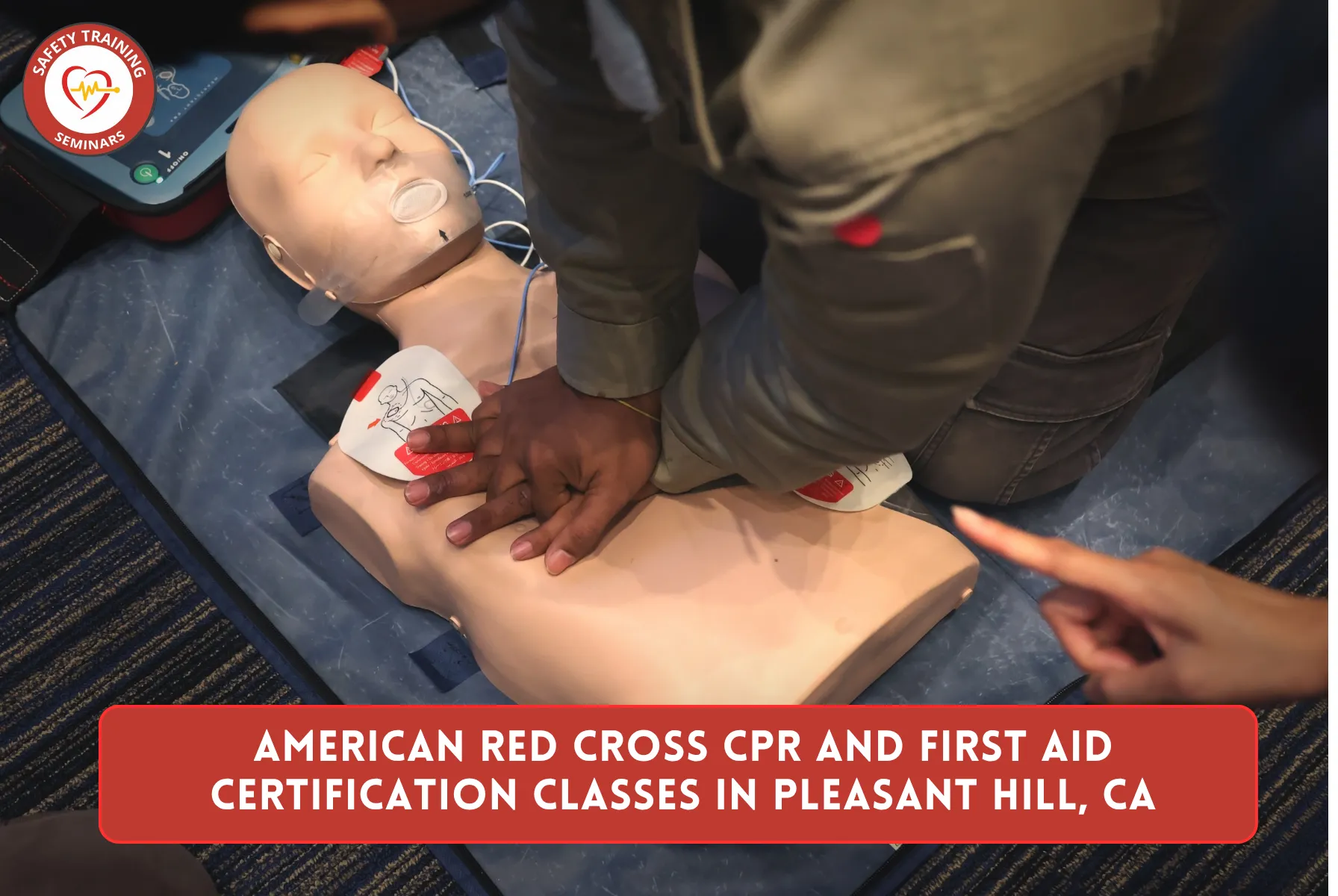
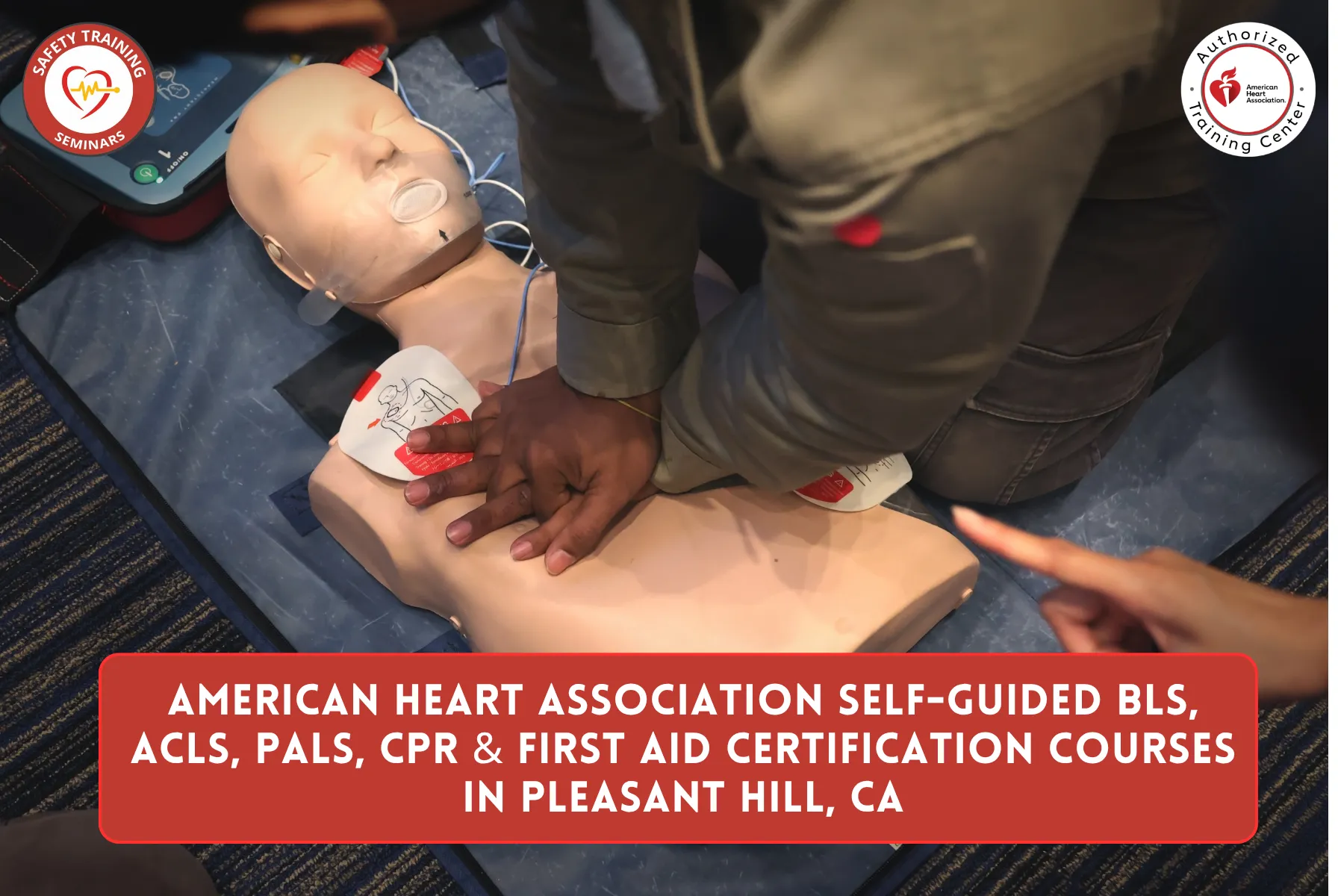
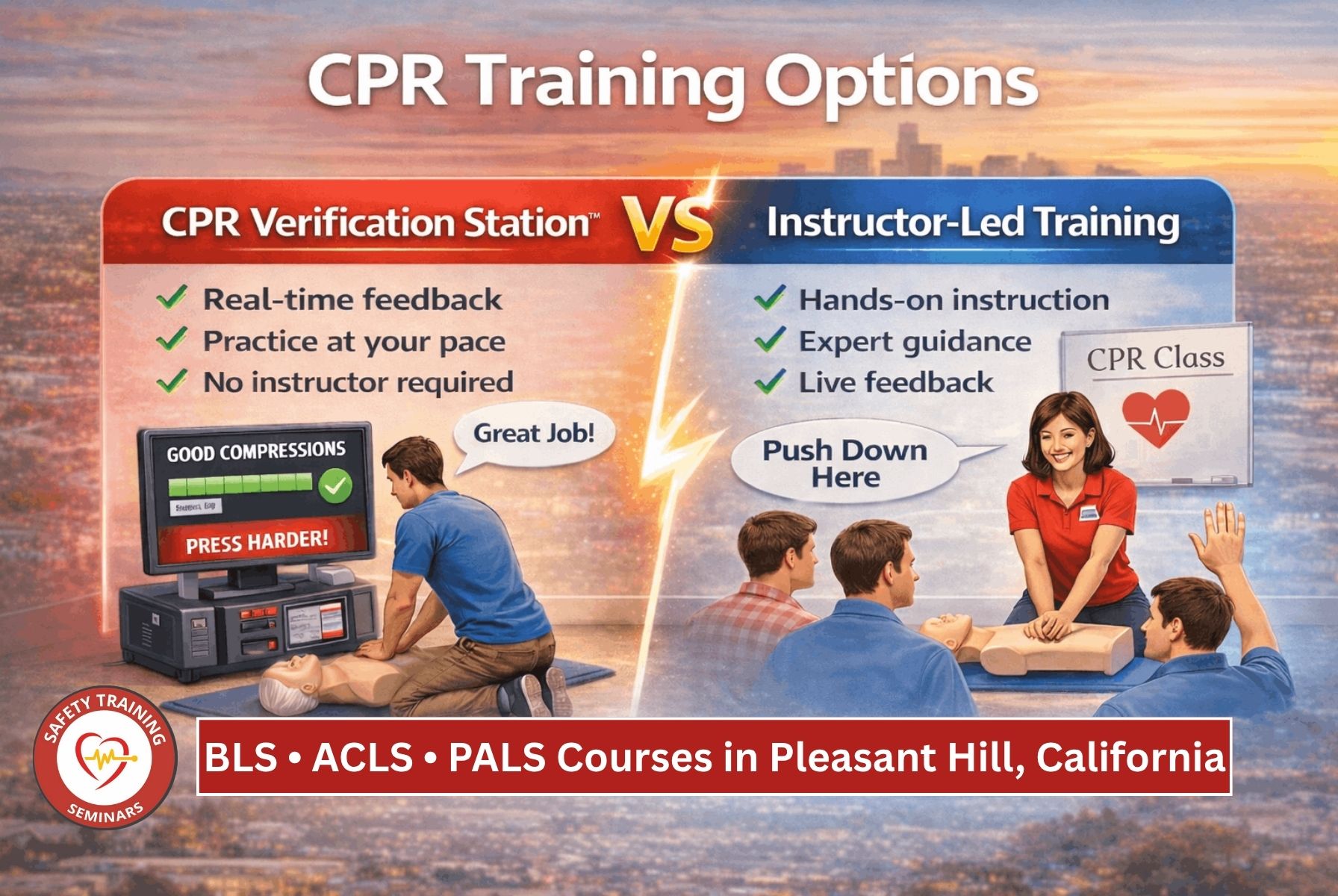
A BLS or CPR class combines a short lecture portion with hands-on skills practice on training manikins. You’ll review how to recognize a cardiac emergency, how to call for help, and how to perform compressions at the correct rate and depth. Most classes also include AED training using a practice unit, so participants get comfortable applying pads and following the device’s prompts.
Instructors typically observe each participant’s technique directly rather than relying only on a written test. For BLS specifically, expect practice in two-person response scenarios, since real workplace situations rarely involve just one rescuer. A knowledge check, whether written or completed online beforehand, is usually part of the certification process as well.
Full BLS Course or Community CPR Class: How to Decide
The clearest way to choose is to check what’s actually being required of you, since guessing wrong means paying for a class you may need to retake.
- Choose BLS if your job description, licensing board, or clinical rotation specifically lists “BLS” or “BLS Provider” as a requirement.
- Choose CPR/First Aid if you’re a parent, coach, teacher, or general employee without a healthcare-specific requirement.
- When unsure, ask your employer or program coordinator directly rather than assuming either course will satisfy the requirement, since the two aren’t interchangeable for compliance purposes.
How Long Certification Lasts
BLS and CPR certifications are generally valid for two years from the date of course completion, after which renewal training is required to stay current with updated technique and guidelines. Many employers and licensing programs expect renewal to be completed before the expiration date rather than after, since a lapsed card can affect scheduling or credentialing.
If your card has already expired, some training providers require the full initial course rather than a shorter renewal session, since policies vary by provider. Checking directly with whoever issued your original certification is the most reliable way to confirm your options.
Training Options Beyond Pleasant Hill
Because the Iron Horse Trail runs through several communities along the I-680 corridor, and because John Muir Health serves patients and staff across the wider area, plenty of readers researching this topic actually live or work outside Pleasant Hill itself. Families based closer to the trail’s northern stretch may find it easier to review the CPR and BLS certification schedule in Concord, while those commuting from further along the corridor might compare the BLS and ACLS course options in Danville. Employees who split time between job sites in Clayton can also check the CPR and First Aid training schedule in Clayton for a class date that fits their commute.
Enrolling With Safety Training Seminars in Pleasant Hill
Safety Training Seminars operates a Pleasant Hill training location at 200 Gregory Lane, Suite C103, Pleasant Hill, CA 94523, offering BLS CPR Certification along with related First Aid and ACLS courses. For employees connected to John Muir Health facilities in Pleasant Hill, this gives you a local option to review rather than searching outside the city for a class that fits your requirement.
Before enrolling, confirm which certification level your employer or organization expects, then review the specific course page to check current format and scheduling. Readers coming from further east along the trail corridor may also want to compare the CPR and BLS class schedule in Antioch if that location fits their routine better than a trip into Pleasant Hill.
Frequently Asked Questions
Do I need BLS if I just work near John Muir Health, not for the hospital directly? It depends on your specific employer and role. Some clinics, medical office tenants, and affiliated practices near John Muir Health facilities require BLS, while others accept general CPR/First Aid. Confirm directly with your employer rather than assuming based on proximity to a healthcare facility.
Is a general CPR class enough for a parent who’s often on the Iron Horse Trail with kids? For most parents and caregivers, yes. A standard CPR and First Aid course covers the skills most relevant to a family or trail-related emergency. BLS is typically only necessary if a school, coaching program, or employer specifically requires that certification level.
Does an online-only certificate count for either course? Usually not by itself. Most employers and organizations require a hands-on skills check completed in person, since technique can’t be verified through an online module alone. Many providers offer a blended format that pairs online coursework with a short in-person skills session.
How soon before my certification expires should I renew? Renewing 30 to 60 days ahead of the expiration date is common practice, since it avoids a lapse without adding extra time to the new certification period. If your card has already expired, ask your training provider whether you qualify for a renewal course or need to retake the full class.
Can I attend a class outside Pleasant Hill if it fits my schedule better? Yes. Safety Training Seminars offers courses at several nearby Contra Costa County locations, so residents commuting from Concord, Danville, Clayton, or Antioch can often find a class date closer to home or work.
Choosing the Right Class Before You Register
The most useful step before signing up is confirming exactly which certification is required, whether that’s coming from a John Muir Health-affiliated employer, a licensing board, or simply your own comfort level as a parent spending time on the Iron Horse Trail. Once that’s clear, the choice between a BLS provider course and a general CPR/First Aid class becomes straightforward.
Safety Training Seminars’ Pleasant Hill location offers both course types, with additional Contra Costa County options for readers whose commute or schedule points toward a different city. Review the course page that matches your situation to check current class format before enrolling.