Ask around the Diablo Valley College campus off Golf Club Road and you’ll find plenty of students who have been told, sometimes on short notice, that they need a CPR card before a clinical rotation, internship, or campus job can begin. They aren’t the only ones in Pleasant Hill, California, looking for training. Youth soccer coaches, preschool teachers, office managers near the BART station, and adult children caring for aging parents all end up searching for American Red Cross CPR and First Aid certification classes in Pleasant Hill, CA.
The good news is that the options are easier to sort than they first appear. American Red Cross training generally falls into four groupings: CPR, First Aid, CPR/AED, and a combined First Aid/CPR/AED course. Many are offered in adult, pediatric, or adult and pediatric versions. Once you know who is asking for your certificate and what they expect, choosing the right class becomes a fairly quick decision.
The Short Answer
Pleasant Hill residents, students, and workers can choose American Red Cross CPR, First Aid, or combined First Aid/CPR/AED training based on what an employer, school, childcare program, or personal goal calls for. Confirm the exact course title with whoever requested it, then look for a local class that matches. Safety Training Seminars runs a Pleasant Hill training center that offers CPR and First Aid options for local learners.
How CPR, First Aid, and AED Training Fit Together
Think of these three subjects as overlapping circles rather than separate classes.
CPR is focused on one situation: a person who has stopped breathing normally or whose heart has stopped. Training teaches learners to recognize that emergency, call for help, and perform chest compressions and rescue breaths.
First Aid reaches much wider. It prepares people to respond to injuries and sudden illnesses, the kinds of situations that happen far more often at work, school, and home than cardiac arrest does.
AED training teaches how to use an automated external defibrillator, a portable device that can analyze a heart rhythm and deliver a shock if needed. Because AEDs are used alongside CPR, the two are commonly taught together.
For many learners, a combined First Aid/CPR/AED course is the practical choice because it covers the widest range of situations in a single class. The American Red Cross describes its Adult and Pediatric First Aid/CPR/AED course as designed for students who need certification that satisfies OSHA workplace or other regulatory requirements, with a digital certificate valid for two years upon successful completion.
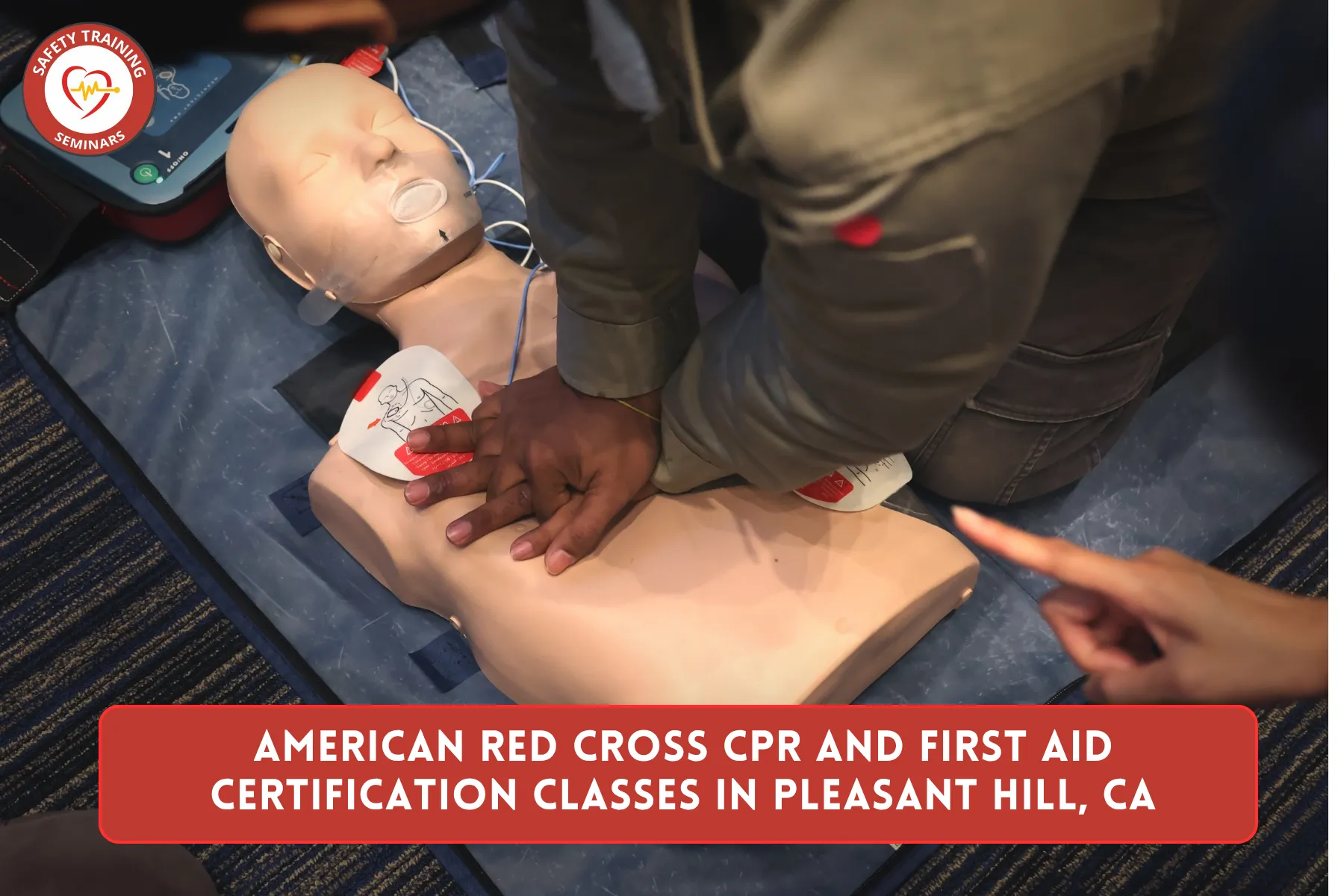
Formats matter too. Some Red Cross courses use blended learning, where you complete an online portion before attending an instructor-led skills session. That hands-on session is where learners practice compressions and AED use on manikins and demonstrate skills to an instructor. Many employers and programs specifically want a certificate that includes this in-person component, so check before choosing an online-only option.
First Aid and AED Training: Often the Bigger Need
In a city with active parks, youth sports, and busy schools, First Aid skills may come into play more often than CPR alone. A scraped knee on a playground, an allergic reaction at a team practice, or a coworker who suddenly feels faint are all situations where First Aid training applies.
People in Pleasant Hill who commonly look into First Aid/CPR/AED training include:
- Coaches and recreation staff working youth leagues, camps, and after-school programs
- Preschool and childcare workers, who may need pediatric-focused training
- Teachers and classroom aides in local public and private schools
- Office and retail employees designated as workplace first responders
- Fitness instructors at gyms and studios
- Home caregivers supporting older relatives
AED knowledge ties these groups together. More workplaces, schools, and recreation facilities now keep AEDs on site, and knowing how to open the device and follow its prompts is a skill worth practicing before you ever need it. If your role puts you near an AED, a CPR/AED or First Aid/CPR/AED course makes sense. Learners comparing formats can explore First Aid and CPR training options in Pleasant Hill to see what’s currently offered.
CPR Training for Adults, Children, and Infants
CPR courses differ mainly in which age groups they cover. Adult CPR suits many workplace settings. Anyone responsible for children, including babysitters, parents, childcare staff, and camp counselors, should look for a course that also teaches child and infant CPR, since techniques change with the size of the person.
Healthcare-bound students should pay close attention here. Dental, clinical, and other health programs frequently ask for Basic Life Support (BLS) instead of standard CPR. BLS is aimed at healthcare settings and differs from community-level CPR courses. If your program handbook mentions BLS, general CPR may not satisfy it. Pleasant Hill learners in that situation can review BLS, ACLS, and PALS classes near Pleasant Hill alongside CPR options.
Who Takes These Classes Locally?
College Students
Diablo Valley College’s main campus sits off Interstate 680 in Pleasant Hill. Its program offerings include dental hygiene, dental assisting, athletic training, allied health, and child care provider pathways. Each of these programs may have its own certification requirements before clinical work or placements begin. Your program coordinator is the best source for the specific course name.
Parents and Family Caregivers
Pleasant Hill is largely residential, with many families and older adults. A household with young children and an aging grandparent may benefit from adult and pediatric First Aid/CPR/AED training, even when nobody requires it.
Workplace Employees
Employers in Pleasant Hill and neighboring Walnut Creek, Concord, and Martinez sometimes designate staff to respond to on-site emergencies. Training requirements vary by employer and industry, so ask your safety coordinator or HR team which course they expect.
Healthcare Support Staff
Medical offices, dental practices, and senior-care settings across central Contra Costa County may request CPR or BLS for front-office, support, and caregiving roles. Requirements depend on the employer and the position.
Choosing a Course Without Guesswork
Before you register, spend five minutes confirming three details with your employer, school, licensing body, or program coordinator: the exact course title, the age groups required, and whether an in-person skills session is needed.
This quick reference shows how the main course types are generally used. It is not a legal or employment standard.
| Training Type | Typical Use | Common Fit |
| CPR | Responding to cardiac and breathing emergencies | Individuals wanting core skills |
| First Aid | Responding to injuries and sudden illness | Recreation staff, office responders |
| CPR/AED | CPR paired with defibrillator use | Fitness staff, facility employees |
| First Aid/CPR/AED | Broader coverage across all three | Childcare workers, coaches, teachers |
If your requirement mentions “pediatric,” “BLS,” or “OSHA,” those words narrow your options considerably. Match them exactly.
Getting to Class in Pleasant Hill
Pleasant Hill is compact and well connected. Interstate 680 runs through the city, and the Pleasant Hill/Contra Costa Centre BART station links residents to the broader East Bay. For DVC students, commuters, and residents of neighboring Walnut Creek, Concord, and Martinez, a local training center can shorten the trip to a skills session. Blended courses reduce classroom time further, since the online portion can be completed at home beforehand.
Safety Training Seminars in Pleasant Hill
Safety Training Seminars offers CPR and First Aid training at its local training center: 200 Gregory Lane, Suite C103, Pleasant Hill, CA 94523.
Before registering, compare the course titles listed on the Pleasant Hill course page with the requirement you received. Check the format (blended or fully in-person), the age groups covered, and the available class dates. If anything is unclear, contact the training center before booking rather than after.
Why Consider Safety Training Seminars in Pleasant Hill, CA?
Several practical factors are worth weighing. The training center is located within Pleasant Hill itself, which keeps travel short for residents and nearby communities. The course lineup includes CPR, First Aid, and AED training, along with healthcare-focused BLS, ACLS, and PALS options, so students and professionals can find related courses in one place. Course details and registration are available online, making it easy to compare options before you commit.
Frequently Asked Questions
Can DVC students get CPR certified in Pleasant Hill?
Yes. Diablo Valley College students can take CPR and First Aid training at local providers in Pleasant Hill. However, health-related programs such as dental hygiene or dental assisting may require BLS rather than standard CPR. Confirm the exact certification your program lists before you register, so the course you complete counts toward your requirement.
What’s the difference between CPR/AED and First Aid/CPR/AED?
CPR/AED covers cardiac and breathing emergencies along with defibrillator use. First Aid/CPR/AED adds training for injuries and sudden illnesses, giving broader coverage. Coaches, childcare workers, and teachers often choose the combined course, but your employer or program may specify one or the other.
Do youth coaches in Pleasant Hill need CPR and First Aid training?
Often, but it depends on the league or organization. Many youth sports and recreation programs ask coaches and volunteers to complete CPR/AED or First Aid training. Check with your league administrator or program director for the specific course and whether pediatric skills are required.
Is an online-only CPR class enough?
Sometimes not. Many employers, schools, and regulatory requirements expect a certificate that includes an in-person skills session. Blended learning courses combine online coursework with hands-on practice. Ask whoever requested your certification whether online-only training is acceptable before enrolling.
How often do I need to renew?
Many American Red Cross CPR and First Aid certificates are valid for two years. Your employer or program may have its own renewal schedule, so check your organization’s policy and note your certificate’s expiration date so you can plan your renewal class ahead of time.
I live in Martinez or Concord. Is Pleasant Hill a practical place to train?
It can be. Pleasant Hill sits between Martinez, Concord, and Walnut Creek, with I-680 and BART nearby. Many central Contra Costa residents find a Pleasant Hill location convenient for the in-person portion of training. Compare class times with your schedule before booking.
Finding Your Class in Pleasant Hill
CPR prepares you for cardiac and breathing emergencies. First Aid covers the injuries and sudden illnesses that come up far more often. A combined First Aid/CPR/AED course brings both together, and it’s the choice many coaches, teachers, and caregivers make.
Whichever way you lean, the requirement you’ve been given should shape the decision. Check the exact course title with your employer, school, or program first. When you’re ready, the Safety Training Seminars Pleasant Hill course page lists current CPR and First Aid classes, formats, and dates, so you can pick a session that fits between work, classes, and family commitments here in central Contra Costa County.